
Compliance & Risk
For organizations that work with self-employed professionals and freelancers, compliance is no longer a side issue. Legislation around hiring self-employed contractors, false self-employment, and liability means employers need to manage external talent with increasing care. At the same time, the number of self-employed professionals continues to grow, and organizations are becoming more dependent on flexible labor.
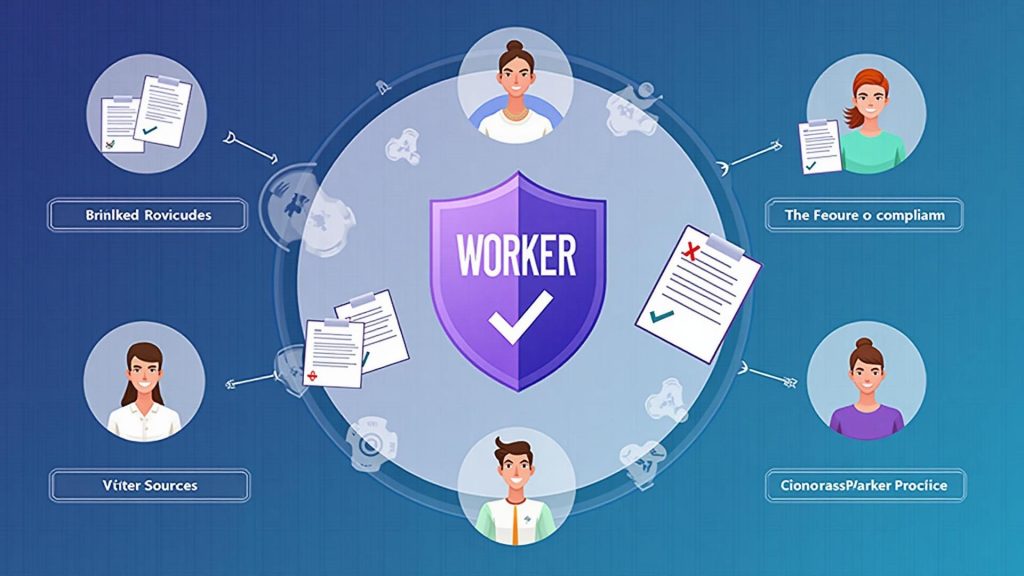

Generate contracts automatically using AI with industry-specific templates and compliance requirements.
Ensure regulatory compliance across all jurisdictions with automated legal requirement checking.
Real-time collaboration tools with approval workflows and version control for team efficiency.
For organizations that work with self-employed professionals and freelancers, compliance is no longer a side issue. Legislation around hiring self-employed contractors, false self-employment, and liability means employers need to manage external talent with increasing care. At the same time, the number of self-employed professionals continues to grow, and organizations are becoming more dependent on flexible labor.
That is why self-employed contractor compliance is not just about following rules. It is about maintaining control. Control over collaborations, agreements, roles, and risks. For organizations that work with large numbers of self-employed professionals, that is essential.
Self-employed contractor compliance means that collaboration with independent professionals complies with laws and regulations and that risks remain manageable. It is not only about contracts, but above all about how the collaboration is structured in practice.
Employers share responsibility for preventing false self-employment, disguised employment relationships, and other compliance risks. This means that hiring self-employed professionals must be assessed structurally, not only at the start, but throughout the entire collaboration.
In many organizations, the use of self-employed professionals grows organically. Departments hire contractors independently, agreements differ from one team to another, and there is no overall visibility. As long as the numbers remain limited, this may seem workable. But as scale increases, so do the risks.
Compliance then becomes complex because no one has the full picture. Who is working under which conditions, how long do collaborations continue, and where are patterns emerging that may become problematic? Without a centralized approach, this remains invisible.
A common misconception is that self-employed contractor compliance is mainly a legal issue. Contracts are of course important, but what happens in practice is decisive. How is someone managed, how independently do they work, and how embedded is the contractor within the organization?
Especially in long-term assignments or fixed roles, compliance can come under pressure. This often happens unintentionally, but the consequences can be significant.
When self-employed contractor compliance is not properly organized, employers face real risks. These include reclassification of the working relationship, retroactive tax assessments, fines, and reputational damage. In audits, tax authorities look at patterns and structural ways of working, not isolated incidents.
For organizations that work with many self-employed professionals, this means risks can quickly accumulate when there is no clear overview.
Effective compliance starts with visibility. Visibility into who is being hired, for which role, for how long, and under what agreements. But also insight into how collaborations evolve over time.
Organizations that take self-employed contractor compliance seriously treat it as part of their broader freelance and external hiring policy. Not reactively, but structurally.
Enabl Works helps organizations make self-employed contractor compliance manageable by providing structure and visibility. Not by replacing legal advice, but by creating the right conditions for control.
Within the platform, collaborations with self-employed professionals are recorded centrally. Roles, agreements, and deployment are visible, making risks easier to identify at an early stage. This helps organizations make timely adjustments and more deliberate decisions around contractor hiring.
By no longer spreading contractor hiring across departments and tools, organizations create clarity and calm. Compliance stops being a separate project and becomes part of the way the organization operates.
Self-employed contractor compliance is not an end goal, but a foundation. Organizations that manage compliance well find that working with self-employed professionals becomes more professional. There is greater clarity, less discussion, and more trust.
This makes it possible to use self-employed talent sustainably, without unnecessary risks.
For employers that work with many self-employed professionals, compliance is unavoidable. Not as a burden, but as a prerequisite for remaining flexible.
By organizing contractor hiring centrally and making it transparent with software such as Enabl Works, organizations gain control. Not through rigid oversight, but through visibility. And that is exactly where mature self-employed contractor compliance begins.
Protect your business with automated worker classification and proactive compliance monitoring.